Frequency Containment Reserve (FCR) and automatic Frequency Restoration Reserve (aFRR)
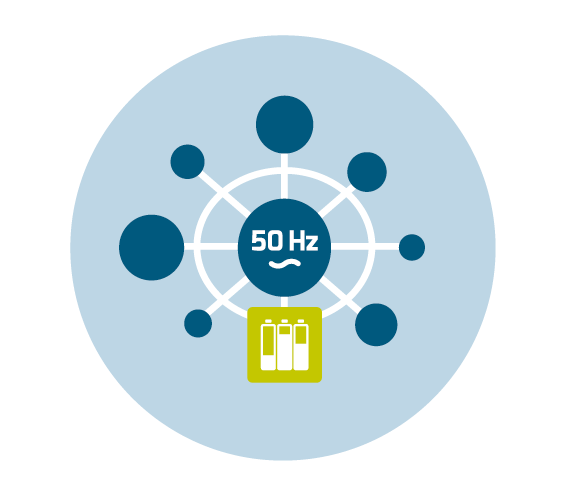
Frequency Containment Reserve (FCR)
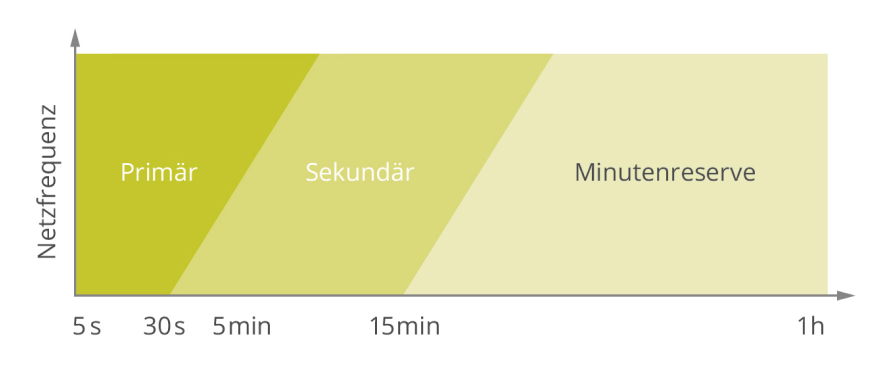
AC networks in Europe have a nominal frequency of 50 Hz. The responsible transmission system operators (TSOs) must guarantee this normal frequency within a narrow bandwidth at all times. Frequency stability is ensured by balancing power generation and consumption. If there are deviations between generation and consumption, a frequency drift occurs and the grid frequency changes. By providing frequency containment reserve (FCR), this frequency drift is stopped and the grid frequency is thus stabilized. The FCR must be fully activatable within 30 seconds and available for at least 15 minutes.
In Germany, there are four transmission system operators, each of which ensures a balance between electricity feed-in and withdrawal and the provision of balancing energy in their grid areas and cooperates in the grid control network. The costs for this are refinanced via the network charges. This association was extended to include Denmark, Belgium, the Netherlands, Switzerland, France and Austria.
Automatic Frequency Restoration Reserve (aFRR)
The term automatic frequency restoration reserve (aFRR) is also often used in connection with FCR. Transmission system operators use aFFR to regulate the frequency back to 50 Hz in case of deviations. The aFRR is subordinate to the primary reserve (FCR) and replaces it. The primary control power initially stabilizes the grid frequency to a frequency that deviates from the nominal frequency. The secondary control power then ensures that the frequency returns to the nominal frequency. Secondary control power must be available in full for 15 minutes within 5 minutes. As a positive aFFR, it can supply additional power to the power grid in the event of under-supply, or as a negative aFFR, it can draw power from the power grid in the event of over-supply.