Ultracapacitor Systems

Why are ultracapacitors needed?

And which applications can be powered by them?

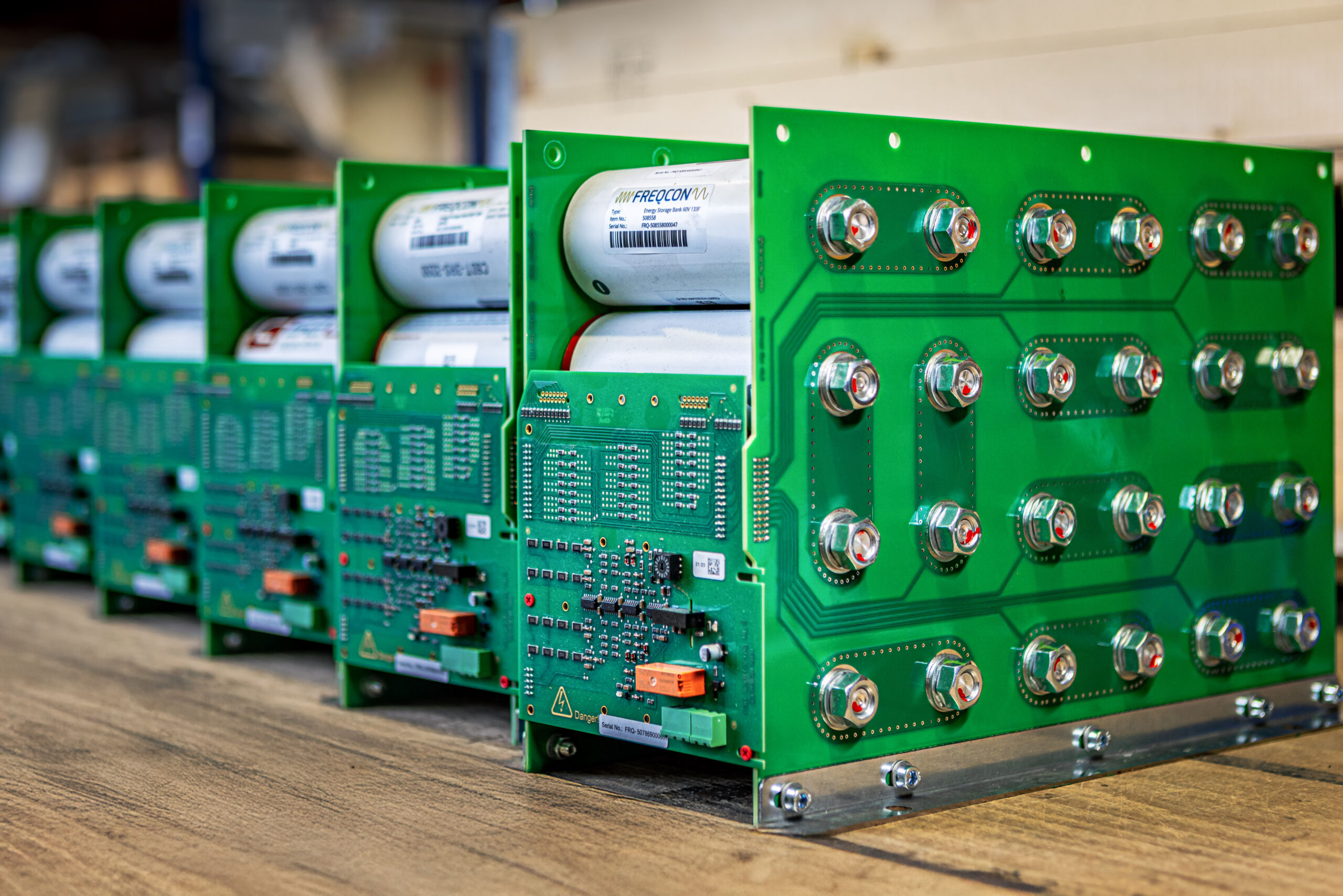
At Freqcon, we design and build two different ultracapacitor systems. Ultracapacitors, also known as supercapacitors, are electrochemical double-layer capacitors that can be used as a fast-reacting energy storage solution.

<br>Ultracapacitor grid stabilizer, voltage stabilization, and double-layer capacitors for frequency stabilization. Supercapacitors enable the integration of renewable energy sources such as solar and wind power into the grid, providing uninterruptible power supply.

What role do ultracapacitors play in the integration of renewable energy sources such as solar and wind power?

With the increasing integration of renewable energy sources such as solar and wind power into the grid, electricity generation is becoming more decentralized and distributed. This shift introduces new challenges, particularly unpredictable fluctuations in grid stability due to the intermittent nature of renewables.
As a result, there is a growing demand for advanced grid services, including primary and secondary frequency regulation, to maintain the stability and reliability of the power network.

Moreover, the rise of decentralized power generation, especially in remote areas, can lead to weaker grid sections. These weaker grids are more susceptible to power quality issues such as voltage sags and micro-outages, which can impact the stability and performance of the entire electricity network.
Ensuring a robust and reliable grid in this evolving energy landscape requires significant investments in grid services and infrastructure to effectively manage this growing complexity.

What is an Ultracapacitor Grid Stabilizer (UGS)?

As the demand for grid services—such as primary and secondary frequency regulation—continues to grow, more and more battery energy storage systems (BESS) are being deployed. Providing power for these grid services represents a significant revenue opportunity.
Conventional power generation units, such as hydro turbines or gas turbines, cannot participate efficiently in the grid services market due to their slower response times.

Large machines, such as hydro turbines, require time to ramp up or ramp down in order to provide power for primary or secondary frequency regulation. If this process occurs too quickly, the turbine can suffer mechanical and physical damage, which not only reduces its overall lifespan but also increases maintenance costs.

Therefore, a solution is needed that can deliver the required power for grid services instantly, while the larger power generation units gradually ramp their output up or down accordingly.

Lithium-ion battery energy storage systems are often oversized for this application because the C-rates of the batteries are limited. (The C-rate refers to the charge or discharge current relative to the battery’s rated capacity in ampere-hours [Ah].)
In addition, lithium-ion battery solutions are typically limited to just two cycles per day and experience significant degradation over time, making them less suitable for rapid, high-frequency grid service applications.

Freqcon has developed a solution based on ultracapacitors, which is perfect for this scenario. Ultracapacitors exhibit minimal or no degradation and can be discharged over a million times during a lifespan of 10 to 20 years.

We primarily use ultracapacitors for systems where we need to provide very high power for very short periods. The ultracapacitors are current-resistant, cycle-resistant, fast in response, and can immediately meet the demands we place on them. Overall, they are very space-efficient, low-maintenance, and ensure a long service life.

The ultracapacitor-based energy storage system is designed to provide power for up to 60 seconds, which is sufficient for the conventional power generation unit to catch up. In this combination, conventional power plants, such as hydropower plants, can participate in the grid services market without significant investments.

Hybrid projects: Ultracapacitor Grid Stabilizer (UGS) + (Hydro-) Power Plants = Grid Services

Hydropower generation remains one of the most stable and important forms of electricity generation in Europe, particularly in Norway, Sweden, and Finland. Hydropower plants generate electricity in gigawatts and, due to the physical and mechanical limitations of the large turbines, unfortunately cannot participate in the grid services market. The same applies to river hydropower plants, which range from 10 to 100 megawatts. The result is that at least several hundred megawatts cannot be used to stabilize the power grid, requiring alternative solutions such as lithium-ion battery storage.

In combination with Freqcon’s UGS, conventional power plants with their typically slow response times can immediately contribute to grid services and grid stability. Freqcon’s container solution can provide power from 1 MW to >100 MW within 150 ms. This fast power delivery qualifies the hybrid power generation unit (Freqcon UGS + water turbines) to participate in grid services.

The UGS provides power for up to 60 seconds while the water turbine adjusts to take over the power supply for the remaining time (15 to 30 minutes). This process can occur multiple times in a single day, as the ultracapacitors can go through >1 million cycles.

<br>Ultracapacitor grid stabilizer, voltage stabilization, and double-layer capacitors for frequency stabilization. Supercapacitors enable the integration of renewable energy sources such as solar and wind power into the grid, providing uninterruptible power supply.

Case Study: UPM – Application Example of a Finnish Hydropower Plant

UPM Energy is the second-largest electricity producer in Finland. In 2021, Freqcon was commissioned to design and install an ultracapacitor-based grid stabilizer system for the hydropower plants in Katerma and Kallioinen on the Ontojoki River. The 3 MW system consists of a multi-source inverter and 504 ultracap modules housed in two 40-foot containers. Additionally, the project included supporting measures for system integration into the power plant grid.

In conjunction with the hydropower plants, the short-term storage can respond to disturbances within milliseconds, ensuring power supply for up to one minute before the hydropower plants take over this task. The combination of the hydropower plant and high-performance ultracapacitor storage is becoming a key pillar for the reserve market. This is because the short-term storage is capable of quickly and seamlessly handling load changes without capacity losses, even over millions of cycles.

Business Case – Additional Revenue Streams through the UGS

By using the UGS, slower-responding power plants can be enhanced, opening up new markets. In combination with Freqcon’s UGS, a wide variety of power plants can immediately contribute to grid stability and provide grid services.

Examples of these grid services include: FCR-N and FFR, as well as FCR-D and aFRR.

FCR-N stands for “Feedback Control Rule – Net” and is a model in the context of regulating electricity markets, specifically related to grid frequency. FCR-N is a frequency control mechanism in power grids. Here, FCR stands for “Frequency Containment Reserve” and N for “Normal,” indicating that this regulation is applied under normal conditions (not in emergency situations).

The FCR-N is designed to maintain grid frequency stability by providing rapid balancing energy when deviations occur, such as when the balance between electricity generation and consumption is disrupted. This balancing energy is supplied by power plants or other suitable generation units that can quickly adjust their output to correct fluctuations in grid frequency.

Overall, FCR-N is a crucial component of grid stability, ensuring that the power supply remains reliable despite fluctuations in generation and consumption.

FFR stands for “Fast Frequency Response” and refers to a specific type of frequency control in power grids. FFR is a very rapid response to frequency deviations, activated within fractions of a second (often within 1-2 seconds), to stabilize the grid frequency.

FFR becomes necessary when there are sudden and large imbalances between electricity generation and consumption, such as the sudden failure of a large power plant or an unexpectedly sharp change in load. In such situations, the grid frequency can rapidly drop or rise, potentially leading to grid instability and, in the worst case, large-scale power outages.

FFR can be provided by various technologies, including:

– Battery storage systems: Due to their extremely fast response times, battery storage systems are particularly well-suited for FFR.
– Fast-starting gas turbines: These can ramp up and provide power within seconds.
– Demand Response: This involves quickly reducing the electricity consumption of specific consumers (e.g., industrial plants) to stabilize the grid frequency.

The implementation of FFR is especially relevant in power systems with a high share of renewable energy. Renewable energy sources like wind and solar power can cause more unpredictable fluctuations, which require a rapid response for frequency stabilization.

Your project with Freqcon – What exactly can we deliver, do, and provide?

At Freqcon, we bring our three decades of experience to deliver the highest quality to our customers. We work with our clients from the start of the project through to delivery and the successful commissioning of the project.

Problem Analysis

Freqcon can assist in analyzing load profiles and determining the best solution for problems, whether it’s a battery storage system or a system based on ultracapacitors.

Project Sizing

Freqcon can size the duration of energy storage, the required power of the system based on your load profile, power demand, potential applications, system availability, years of functionality warranty, and more!

Project Management

After the order, Freqcon’s specialized project managers assist with collaboration with third parties, coordination, and project sales, and are always happy to be helpful and accessible. Whether by phone, video, or in person on-site.

Product Manufacturing and Integration

Freqcon manufactures the inverter and ultracapacitor modules in-house. The scope of supply for Freqcon products includes containers, wiring, auxiliary and own consumption devices including power supply, medium voltage transformers, and medium voltage switchgear.

Delivery and On-Site Installation

Freqcon also handles transportation and delivery (optional including unloading on-site). The customer receives a turnkey solution with minimal integration effort at their chosen location (subject to feasibility).

Commissioning

Freqcon’s experienced engineers also carry out the commissioning of the project on-site, including successful integration and communication with the customer’s devices and other local infrastructure.

Maintenance

Das Freqcon-Serviceteam bietet eine Wartung sowohl vor Ort an, als auch eine Fernwartung, um das System so lange wie möglich optimal betriebsbereit zu halten und so den maximal möglichen Nutzen zu erzielen.

Ultracapacitor Uninterruptible Power Supply (UUPS)

With the integration of robots and automated machines, an increasing number of companies are relying on a growing number of sensitive machines. The issue is that the grid quality is sometimes suboptimal, and even the smallest voltage dips of 5 to 10% over short periods can, for example, cause a misalignment of the robotic arm. Similarly, data centers can lose critical data and constantly switch to UPS mode when connected to a poor power grid. Such incidents can result in massive financial damage.

At Freqcon, we have developed smart, space-saving, and efficient solutions that help ensure power supply security during power outages and short interruptions, supporting production or operations. To provide maximum support and protect against failures, ensuring that the operation of a production line or process is not disrupted, only one of our ultracapacitor systems is required—no complex company or grid expansion needed.

<br>Ultracapacitor grid stabilizer, voltage stabilization, and double-layer capacitors for frequency stabilization. Supercapacitors enable the integration of renewable energy sources such as solar and wind power into the grid, providing uninterruptible power supply.

Ensuring power quality is actually quite simple – or is it?

Ensuring a safe and reliable power supply for these intelligent machines and processes presents two major challenges:

  • Voltage dips can occur frequently, up to several hundred times a day.
  • The emergency power supply or UPS must respond so quickly that the load is not affected by the grid issues.

Moreover, more than 90% of voltage dips and situations with poor power quality last no longer than 1 second. In modern automation technology, such short voltage dips or even interruptions, down to the millisecond range, can have serious consequences. The systems are highly sensitive and may fail, causing the entire production process to halt or even come to a standstill.

“In Germany, I would say it happens maybe once, twice, or three times a month. In neighboring countries like the Czech Republic, Italy, or Hungary, where the power grids are not as developed, it can happen multiple times a day.” – Marcel Biler, Sales Engineer and Short-Term Storage Expert at Freqcon.

Conventional backup power systems are inefficient and completely overdimensioned for this application. Flywheels and generators must run continuously, leading to constant losses, while battery systems are typically sized for applications lasting 1 hour or even longer.

The UUPS system detects the voltage dip, and when the voltage or frequency falls below the threshold, we can disconnect the grid using our Freqcon disconnectors, establish an islanded network through our inverter, and supply the required energy via the ultracapacitor energy storage. This entire process takes less than 20 milliseconds.

In this way, we can establish an islanded network for a brief moment, provide the required power, and then, once the grid is back and stable, resynchronize and protect the production line or even the entire company from this frequency/voltage dip.

Due to the speed of grid disconnection and the immediate power supply from ultracapacitors or batteries, even the sensitive equipment in modern machines is unaffected, preventing any disruption in production.

The ultracapacitors can be discharged more than 50,000 times per year, and their capacity and functionality can be guaranteed for over 20 years of operation.

This compact solution is perfect for sensitive machines, even when connected to weak power grids.

Application Examples of UUPS

This is also supported by a case example from a customer in the Czech Republic, who can experience such grid dips up to three times a day. These dips last from several hundred milliseconds to two or three seconds. However, even voltage dips, where the voltage falls below certain setpoints, as well as complete blackouts lasting a few minutes, still occur regularly and will continue to challenge us as we transition to renewable energy sources.

Depending on the sensitivity of the equipment, it is crucial to achieve grid disconnection within those 20 milliseconds. Our self-developed and manufactured Freqcon Fast Disconnectors can respond within this time window, which also meets the requirements of modern automotive production lines. We achieve this with thyristor switches, which can block the current within a few milliseconds and grant us grid release within a few more milliseconds, allowing us to provide power in real-time.

What is the difference between UGS and UUPS?

While both systems include Freqcon’s multi-source inverter and ultracapacitor storage as key components, the UGS and UUPS solutions differ in terms of sizing and application.

The UGS is sized to provide power for up to 45 seconds. The main application of the UGS is the rapid response to power demands for various grid services. Meanwhile, the secondary power source can increase (or decrease) the power to provide the required service for a longer duration (15 minutes, 30 minutes, or more). In this combination, conventional slow power generation units can participate in the grid services market or provide a very fast UPS response without running continuously in the background.

UUPS is typically sized for power delivery of 1 to 2 seconds. The main application here is to ensure safe and reliable power quality for sensitive machines. Since voltage dips and weak grid issues occur frequently, the UUPS needs to be ready for many cycles per day. Additionally, the UUPS responds within 20 ms (or in some cases, without delay) to ensure that sensitive machines are not affected by voltage dips.

Zum Vergleich: Der UGS kann innerhalb von 150 ms reagieren, da die Anforderungen an den Netzdienst nicht so streng sind.

What both systems have in common:

Our systems are delivered in turnkey containers. This means that for our customers, the effort is minimal. One cable goes in, one cable goes out. The systems are pre-assembled and meet all the requirements for European grids, adhering to the highest standards in this context. Our systems comply with the necessary regulations of the IEC standard and meet the requirements of VDE and UL standards.

  • The ultra-capacitor uninterruptible power supply system (U-UPS) provides uninterruptible emergency power supply through ultra-fast detection of mains faults, [...]

  • The ultra capacitor grid stabilizer is a combination of STATCOM converter for voltage stabilization and double layer capacitors [...]

You still have questions?

Contact us!

Name *
Company name *
Email address *
Phone number
How can we help? *
Project duration (months) *
You wish
Message